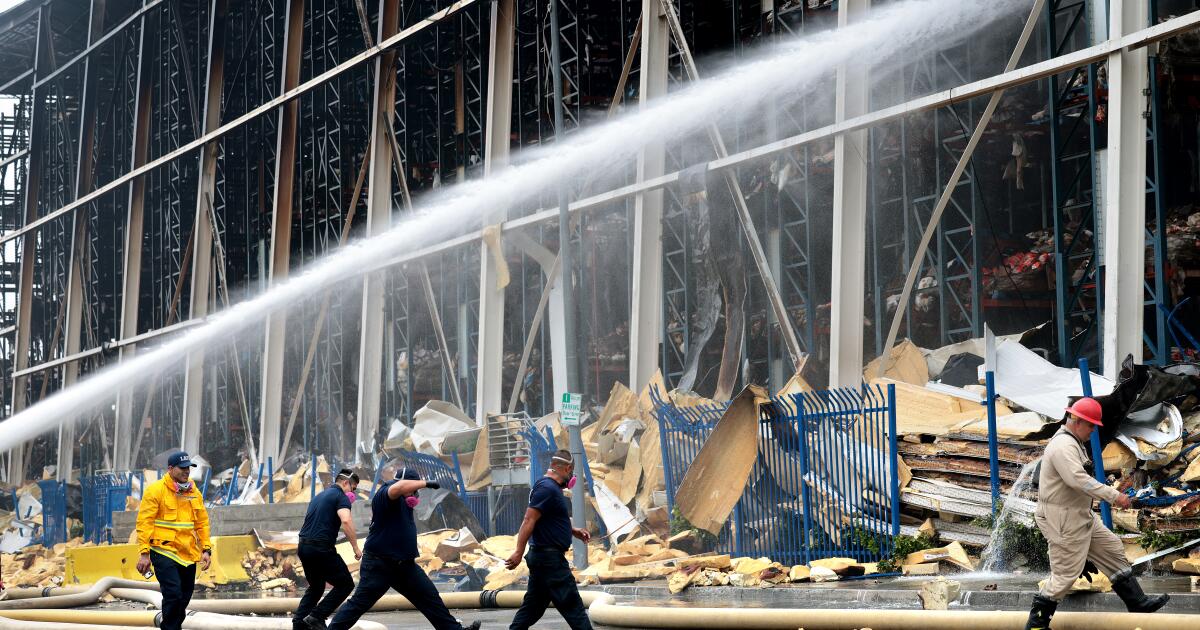
The fire may be out, but Boyle Heights is now dealing with a large amount of rotting meat and a foul smell as the week-long clean-up phase of the fire from the cold storage begins.
Outside the Lineage warehouse on Thursday morning, the smell of heavy smoke was replaced by that of spoiled food and dirty water. Thick foam from the building’s furnace floats over streams leaking from the shell, firefighters have been submerged for days since the fire broke out in the roof on the afternoon of June 17.
Three dump trucks, but firefighters say it will be days before crews can access the charred remains of the interior.
Wendy Ramirez, 45, and her father-in-law, Jaime Ramirez, 69, fled the area when they could no longer bear the heavy smoke last week. They came back on Thursday to check on their house and were greeted by a bad smell.
“Now you can smell rotting food,” said Wendy Ramirez. Two of her children have asthma, and she was living with relatives during the fire.
In the first days after the fire, officials expressed concern that unrefrigerated food could deteriorate to the point of becoming a biohazard. But the temperature eventually stabilized and the threat was eliminated.
But small risks associated with the growing smell persist.
Jaime Ramirez, who went to his daughter’s house in West Covina, brought a mask in case there was any fire left, but said he needed it to detect the smell.
He and other neighbors are concerned that metal-laced food could attract rats and pose another danger to residents like him, who have yet to find it safe to return home. On the third day of the fire, he woke up with a runny nose, sore throat and chapped lips, he said.
The area surrounding the warehouse is home to at least 31,700 workers, about 8 in 10 of whom are Latino, according to a data analysis by researchers at UCLA. About half of them earn less than the Los Angeles County low-income median and more than half may have limited access to paid leave, health coverage or the ability to work remotely, the analysis found.
That means many would not simply stay home or run to avoid exposure to secondhand smoke, said Arturo Vargas Bustamante, director of research at the UCLA Latino Policy & Politics Institute.
The results of the analysis were not surprising, as Boyle Heights has a long history of being targeted for potentially hazardous infrastructure such as warehouses and factories, and residents often have few resources to mitigate the associated long-term health impacts, Bustamante said.
“But I think it’s important to put some numbers into this consideration,” he said, “so that we can anticipate who is most affected and have an idea of what kind of policies should be used to free these people.”
Eastside community organizer with East Yard Communities for Environmental Justice, mark! Lopez, called the area “a bastion of environmental racism in Los Angeles,” pointing to recent oil spills, the polluting legacy of the shuttered Exide battery recycling facility and overcrowding of rail yards and highways.
“On any given day, the air does not breathe, so if you bring disaster to it, you are exacerbating existing problems,” he said.
Lopez believes public officials’ statements downplayed the potential health effects of the heavy smog, which at times filled areas from downtown LA to the San Gabriel Valley with fine particles, known as soot.
If inhaled, these tiny particles can enter the lungs and bloodstream, potentially causing inflammation and swelling. Long-term exposure to secondhand smoke is known to cause heart disease, stroke and other serious respiratory diseases.
As of 10 a.m. Thursday, South Coast Air Quality Management district monitors and low-cost sensors near the warehouse were not detecting high levels of particulate pollution from the fire, regulators said.
But community members and advocates remain concerned about the potential for dirty homes and the long-term health effects, Lopez said. “The real impacts are not what we all saw in the sky,” he said. “That’s what we’ll see in our doctor’s visits in the coming years.”
On Thursday, firefighters continued to pump water into the building, where tall steel stacks could be seen from the remains of a wall that was demolished so workers could battle the flames from inside.
The fire was no longer in danger of spreading, but it will be several days before it stops smoking, said Capt. Anthony Tubbs with the Los Angeles Fire Department.
Fire officials expect to return the building to the tenant, Lineage, and the building’s owner on Friday, said Fire Chief Jaime E. Moore.
A spokesperson for the department said a small number of firefighters will remain at the scene to monitor hot spots and may continue to fire water and debris as a precautionary measure.
The owner and tenant will be responsible for removing the debris and mitigating some of the fire’s effects and consequences, Moore said, including looking at ways to reduce debris flows from the warehouse, as well as odors from rotting food.
In addition to the burned warehouse, millions of pounds of food were also stored in the part of the building that was not affected by the fire.
Public health officials will assist in cleanup and recovery by responding to public health issues, including animal complaints, and helping to ensure that contaminated food is removed and disposed of properly, the Los Angeles County Department of Public Health said in a statement.
Times staff writer Tony Briscoe contributed to this report.