The accused was in an undisclosed prison.
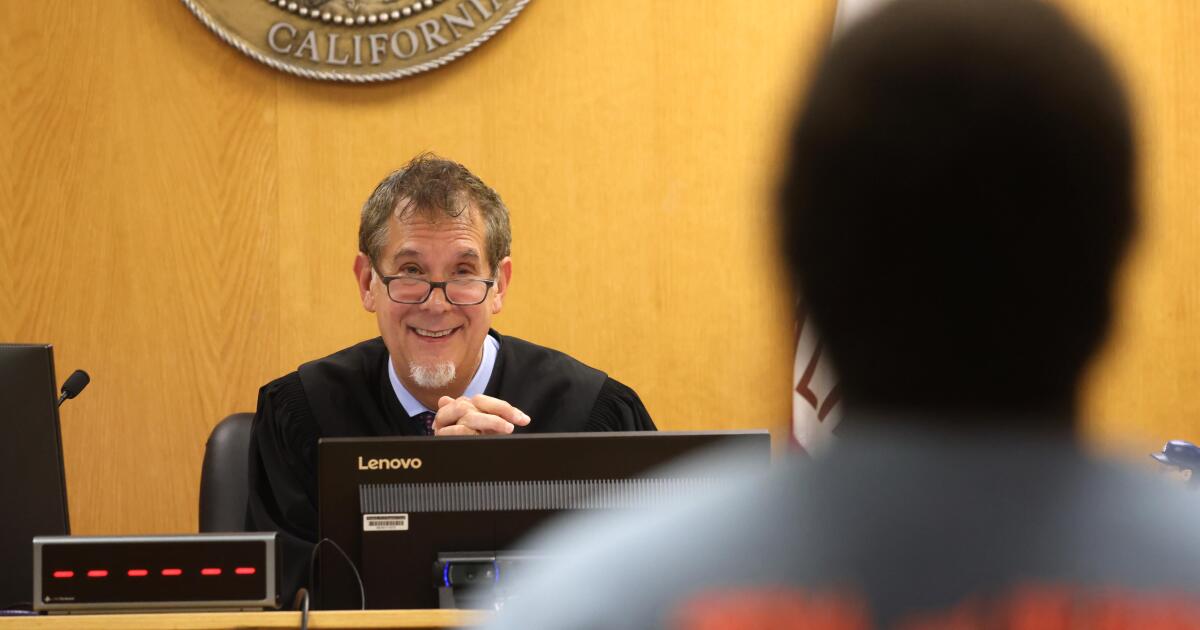
The judge was in Department 213 of the Hollywood courthouse, where he could see the defendant via video.
“Okay, listen,” said Judge Ronald Kaye, who presides over one of the building’s four psychiatric courts. “So a few weeks ago, I made this decision to get you out of jail … and into a hospital for your mental illness.”
But there was a change of plans, Kaye explained, because the defendant was taking his medication and the psychiatrist reported great progress. So Kaye was sending him to a residential treatment center instead of a locked hospital.
“You won’t be wearing a jumpsuit. You’ll be wearing normal clothes. You’ll be able to go to the store after a while. You’ll be able to reconnect with family… It will be a huge freedom,” Kaye said.
However:
“There will be many opportunities, but here are the rules, and these rules do not bend to anyone. No. 1, you cannot leave the house without permission … [or] I’m issuing a bench warrant and taking you back to jail.”
The defendant listened carefully, then interrupted him.
“What if I mess up or something?” he asked. “Like, what are the consequences? I’m just wondering. I’m not trying to say I want to sin, but … what if someone attacks me or something?”
Kaye smiled and said that he rarely gets such a question.
“If someone is staring at you or there’s a confrontation, you have to talk to the staff. You can’t use fists or feet,” said Kaye. “No violence … and you can’t use meth. No meth, no marijuana, no alcohol. Nothing.”
It was a typical day at Kaye’s court, and she was looking forward to one of her favorite activities – graduation ceremonies for people who had completed the treatment program she was describing.
I met Kaye 13 years ago when she represented the family of a 23-year-old mentally ill man. he hanged himself in his cell at LA County’s Men’s Central Jail. The deceased was one of 10 people who died by suicide that year while in custody.
At the time, the county jail system was called the largest psychiatric hospital in the country, and little has changed. Early last year, the Sheriff’s Department put the number of inmates with mental health needs at 46%. Meanwhile, about 25% of homeless people suffer from mental illness, and many of them repeatedly end up in jails, hospitals and courts at great expense without good results.
All of that is unacceptable and sad, which is why I accepted Kaye’s invitation to look for something that works. Mental health courts deal with a variety of legal issues, but one function is to handle the cases of defendants who have made a mistake or crimes, have a serious mental illness and have been judged incompetent to stand trial in a criminal court.
“No. 1 say, do they understand the judicial system?” Kaye said. “The second thing is, can they help their lawyer mentally?”
If they can’t, they can be sent to a state mental hospital or be eligible for mental health care that usually involves a two-year course of treatment. The mental health courts partner with the Office of Separation and Reentry, or ODR, which has directed more than 15,000 defendants with mental, physical and behavioral needs into housing and treatment since the county established it in 2015.
The office “has access to urgent care facilities where people are locked up, and then eventually, with medication and treatment, they can be moved to a residential facility,” Kaye said. “And in the residencies they’re pursuing their dreams, like, getting a GED … but they’re on mandatory medication. … It’s just a game-changer, and we’re the envy of every county in the state of California.”
Judge James Bianco, a former mental health court judge who is now on the ODR court bench, has advocated for the program’s expansion.
“We are doing a really good job, but on a small scale compared to what is needed,” said Bianco. Community-based care was part of the system when mental hospitals were closed 50 years ago, but “the system was under-resourced … and we’re still playing catch-up.”
Bianco and I were part of delegation to Trieste, Italy, in 2019 to study a mental health program that builds lasting therapeutic relationships with patients and serves as a model for the discharge of mental illness. That trip was organized by Kerry Morrison, founder of Hollywood 4wrd, who was looking for answers to the epidemic of severe mental illness and homelessness. Morrison has visited Kaye’s court many times and seen him build relationships with clients.
“You’ll have notes that refer to it. ‘Oh, the last time you were here, you mentioned a birthday, or you’re worried about your mom being sick,'” Morrison said. I call it great hospitality. … He really listens to what they have to say and if there is a setback, I find him very encouraging. ‘This is what you need to do. Do you think you can do this?’
Mental health disorders don’t always work. Some clients break house rules, turn to meth or go AWOL. Some get second chances; some don’t and go back to locking. Even graduates have challenges ahead, because often, although severe mental illness can be controlled, it does not go away.
But Kaye said about four out of five people complete the diversion program, and he celebrates with them when they do. Sometimes therapists and family members join the group, and Kaye leads the ceremony, raising the diploma from the bench.
There were four graduates the day I visited, including two who were going to electrical training school and one who was on his way to ODR housing. I agreed not to use their names or the details of their cases.
“You got separated from the program, and you were AWOL … and I gave you a second chance … and you did well,” Kaye told one of the students, who said he had been sober for two years.
Along with another grad, the clinical director at his clinic sang his praises.
“He has never been in trouble.
Kaye congratulated the client and there was applause in the court.
When it was time for the official to enter the podium, the judge lit up.
“Look who’s here,” said Kaye, who had been monitoring the man’s progress through occasional video conferences.
“He’s encouraging,” said Kaye.
“Thank you very much, your honor,” said the defendant. “I am speechless, you have always encouraged me, thank you very much.”
Kaye mentioned that the man was a good mentor to the young residents at his clinic.
“You were a voice of reason, a voice of commitment to treatment,” said Kaye. “So it is with a heavy heart that I am graduating because I wish that you will stay by my side for the rest of my time on the bench.”
The defendant’s brother came in via video and thanked the judge. It was as if they were at a family meeting.
Kaye then turned his attention to the defendant, who was heading to Knott’s Berry Farm to celebrate with his family. The judge asked the bailiff to bring him the graduation certificate.
“You are the man,” he said. “I’m proud of you.”
“Thank you, your honor.”
steve.lopez@latimes.com